
Last updated on April 18th, 2026 at 10:33 am
A 2026 guide to agentic commerce: how AI agents buy using four protocols—AP2, ACP, MPP, and x402—what each does, when to use them, and integration tips.
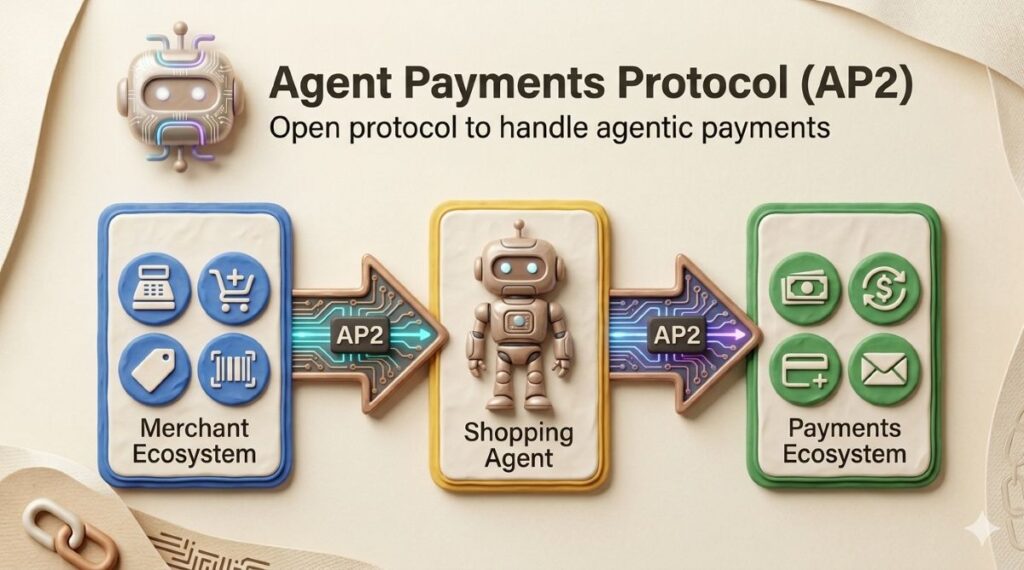
The complete guide to agentic commerce protocols. | Image Source: Gemini AI
This post is a guest submission. Please see our Affiliate Disclosure & Notification for details.
This post may contain affiliate links. We may earn a commission if you purchase an item through our links. It costs you nothing and helps us to fund this blog. Please see our Affiliate Disclosure & Notification for details.
Agentic Commerce Protocols: The Complete Guide
AI agents can now reason, plan, and (when allowed) spend money. The infrastructure for that new buyer is landing fast, and it’s not one standard. It’s a stack of complementary protocols, each solving a specific layer of the problem.
This guide walks through the four protocols every developer building agentic commerce will encounter in 2026: ACP, AP2, MPP, and x402. It covers what each protocol does, when to use it, how they fit together, and where execution infrastructure still has to do the last mile.
What is agentic commerce?
Agentic commerce is online shopping where an AI agent, not a human, drives the transaction. The human sets the goal and the budget; the agent researches, chooses, and checks out. McKinsey projects agent-mediated commerce at $3–4.4T by 2030, but the plumbing has only just shipped.
The core problem: traditional e-commerce assumes a cardholder clicking a button. Agents don’t click. They call APIs, pay programmatically, and need verifiable authorization to do it safely.
The four layers of the agent commerce stack
A production agent commerce flow spans four distinct layers. Each protocol addresses one of them.
Layer 1: Authorization — AP2
AP2 (Agent Payments Protocol) is Google’s open standard for proving a user authorized an agent to spend money. Backed by 60+ partners including Mastercard, PayPal, Amex, and Coinbase. The primitive is a cryptographically signed Mandate — Intent, Cart, or Payment — that travels with the transaction so any party can verify user consent.
Use AP2 when compliance, audit trails, or multi-agent workflows need verifiable authorization. Skip it for low-stakes, single-ecosystem flows.
Layer 2: Merchant checkout — ACP
ACP (Agentic Commerce Protocol) is Stripe + OpenAI’s spec for how agents check out at merchants. Four REST endpoints (create, update, complete, cancel a checkout session) plus Shared Payment Tokens that scope spending to a single merchant and amount.
Use ACP when your catalog lives on Shopify or another ACP-compatible platform. Adoption is strong on Shopify and nonexistent at Amazon, Walmart, and Target.
Layer 3: Machine payments — MPP and x402
Both protocols revive HTTP 402 Payment Required so agents can pay for services inline without API keys or accounts.
- MPP (Stripe + Tempo): Multi-rail (stablecoin, fiat via SPTs, cards via Visa, Bitcoin via Lightning). Session model for high-frequency micropayments. Launched March 2026 with 100+ integrated services.
- x402 (Coinbase): Stablecoin-only, zero protocol fees, crypto-native. V2 launched December 2025; 75M+ transactions in the last 30 days.
Pick MPP if you need enterprise controls or multiple rails. Pick x402 if you are crypto-native and want zero fees. Most serious platforms support both.
Layer 4: Execution — Zinc API
Protocols standardize handshakes. They do not place orders at retailers that haven’t adopted a protocol. For big-box retail — Amazon, Walmart, Target, Best Buy, Home Depot — no standard currently applies, and none is on the public roadmap.
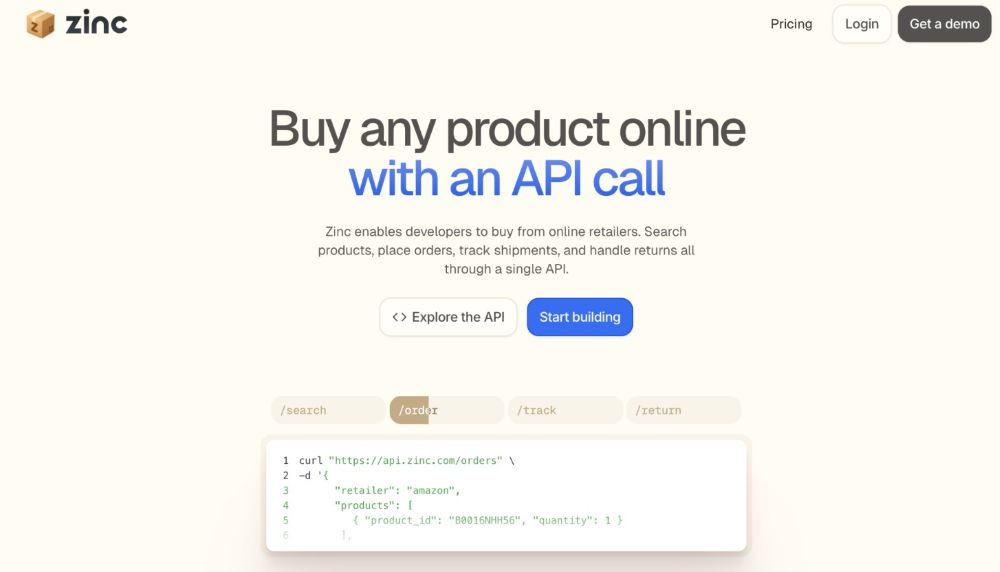
This is where execution infrastructure lives. Zinc API handles programmatic ordering across 50+ retailers through a single integration: accounts, bot protection, 2FA, payment routing, and post-purchase tracking. An agent passes a product URL, shipping address, and max_price, and Zinc turns that into a placed order and a tracking webhook.
How the protocols fit together
A well-designed agent uses all four layers, not one:
- The user signs an AP2 Intent Mandate authorizing the agent to spend within limits
- The agent discovers products, assembles a cart
- If the merchant supports ACP, the agent checks out through the four endpoints
- If the target is an API or service, the agent pays inline via MPP or x402
- For anything at a non-ACP retailer, the agent calls an execution API like Zinc
No layer replaces the others. Vendors pitching a single protocol as “complete agentic commerce” are either assuming Shopify-only catalogs or glossing over the execution layer.
When to use which
| Scenario | Protocol(s) to use |
| Agent buys from Shopify merchants | ACP + AP2 |
| Agent pays APIs and data feeds | x402 or MPP |
| Agent shops at Amazon, Walmart, Target | Execution layer (Zinc) |
| Enterprise procurement with audit trail | AP2 + execution layer |
| Crypto-native micropayments | x402 |
| Multi-rail (fiat + crypto) payments | MPP |
Next steps
If you are evaluating an agent commerce stack today:
- Read the AP2 spec at ap2-protocol.org for authorization
- Read the ACP spec at agenticcommerce.dev for merchant checkout
- Read the MPP spec at mpp.dev and x402 at x402.org for machine payments
- Plan for an execution layer from day one if you need coverage outside Shopify
Protocols move money. Execution moves boxes. Teams that ship production agentic commerce will compose the two.

I'm a lover of all things technology. My favorite topics to write about are web design, SEO, and business marketing.
Subscribe to Our Mailing List
If you found the information in this post helpful, we'd love to have you join our mailing list. We promise we won't spam you, we only send out emails once a month or less.